Two weeks into stroller research, most parents are more confused than when they started. Every brand blog says its model is the one. Every friend has an opinion. The answer is simpler than the ads suggest.
How to choose a baby stroller: Work through five decisions in order, your baby’s age, your daily lifestyle and terrain, the stroller type that fits, non-negotiable safety features, and your honest budget. Then test-drive in person before you buy. Every other detail folds into those five.
This guide walks you through each step with US-specific safety data, real 2026 prices, and an airline gate-check cheat sheet — plus a printable 10-point test-drive checklist you can take to the store. Updated for 2026.
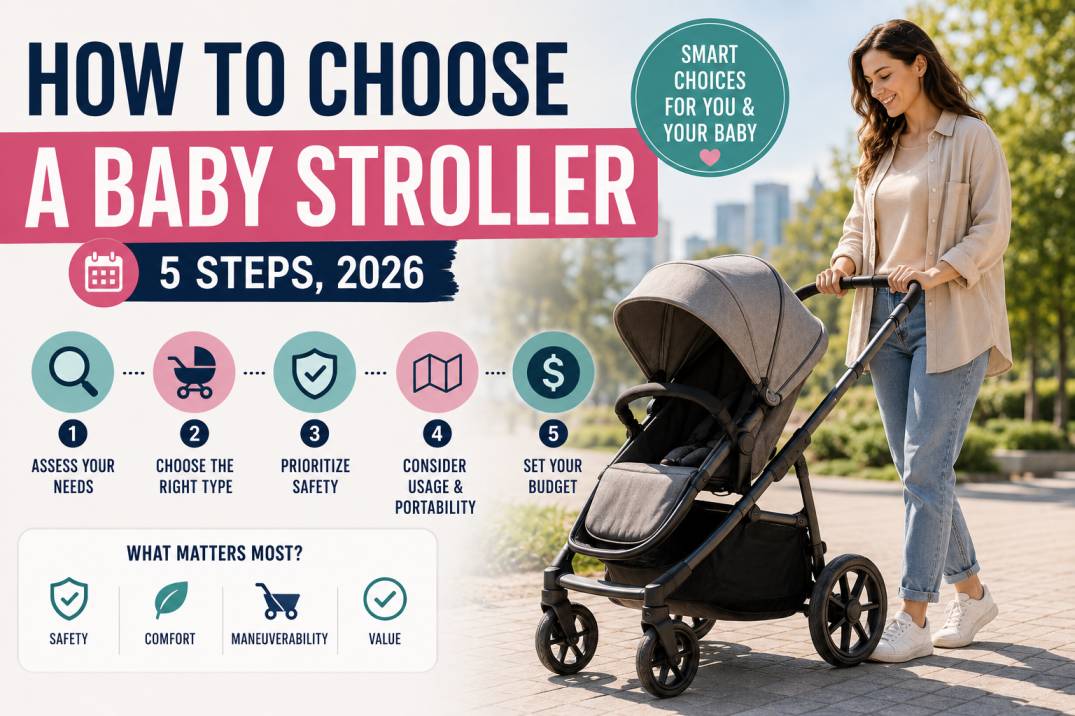
The 5-Step Method
Here’s the whole framework before we unpack it:
- Start with baby’s age → determines what seat configuration you need
- Match your lifestyle & terrain → determines weight, wheels, and fold type
- Pick the stroller type → narrows to 1–2 categories
- Lock safety features → eliminates anything that doesn’t pass the checklist
- Set a budget, then test-drive → final filter, done in person
Run these in order and you’ll eliminate 90% of options before you ever compare fabrics or cup holders.
Step 1: Start With Your Baby’s Age
This is the decision that quietly rules everything else.
Newborns can’t hold their heads up — so a standard upright stroller seat isn’t safe for them. Before a baby has full head and neck control and can sit without support (typically around 6 months, though some babies get there a few weeks earlier or later), the stroller must meet one of these conditions:
- Fully flat recline — the seat lays completely horizontal, like a bassinet
- Bassinet attachment — a detachable flat-bed module that clicks onto the frame
- Infant car seat adapter — the stroller frame accepts a compatible rear-facing car seat
This isn’t a guideline from a parenting blog. It’s standard pediatric guidance cited by KidsHealth from Nemours and the American Academy of Pediatrics.
What Your Stroller Needs at Each Stage
| Baby’s Age | Seat Requirement | Best Options |
|---|---|---|
| 0–6 months | Must lie flat or hold a car seat | Bassinet mode, fully reclining seat, or car seat adapter |
| 6–12 months | Upright seat OK once baby sits independently | Reversible seat (parent-facing still ideal for bonding and monitoring) |
| 12+ months | Full upright use | Forward-facing or parent-facing — most strollers work |
💡 Pro tip: A reversible seat is worth the premium if your baby is under 6 months. Parent-facing lets you check on them easily, and face-to-face interaction matters in those early months. Once they’re curious about the world, flip it forward.
One more thing people miss: when can baby use a jogging stroller? At least 6 months — with full head and neck control — and only on smooth surfaces until about 12 months. Walking-pace use with a bassinet or car-seat adapter is fine earlier. We’ll cover jogging safety specifics in Step 4.
Step 2: Match the Stroller to Your Lifestyle & Terrain
Age tells you what the seat needs. Your daily life tells you everything else.
Be honest about where you’ll push this stroller 80% of the time. That’s the one to optimize for — not the weekend hiking trip you’ll take twice a year.
City / Apartment Living
Best for: Walk-up buildings, sidewalk-heavy neighborhoods, public transit, grocery runs on foot.
What matters most:
- Weight under ~20 lbs: you’ll carry it up stairs. A lot.
- One-hand fold: the other hand is holding a baby. Non-negotiable.
- Self-standing fold: it stays upright when you let go. Critical in small apartments where floor space is precious.
- Swivel front wheels: tight turns around store displays and through doorways.
- Narrow profile : standard US doorways are 30–32 inches wide. Measure yours before buying.
If you don’t own a car, a bulky full-size stroller will make you miserable within a month. Go lightweight.
Suburbs / Daily Driving
Best for: Car trips to daycare, paved sidewalks, park walks, weekend errands with a trunk full of stuff.
What matters most:
- Trunk fit: measure your trunk. Seriously. Folded dimensions are on every product page.
- Travel-system compatibility: if you drive daily, the ability to click a sleeping baby’s car seat directly into the stroller frame is a genuine quality-of-life upgrade.
- Under-seat basket capacity: you’ll load this with diaper bags, groceries, and that one extra outfit. Bigger is better.
- Suspension: cracked suburban sidewalks and gravel parking lots are easier on the baby (and your wrists) with at least basic shock absorption.
Trails, Suburbs with Rough Terrain, or Running
Best for: Gravel paths, unpaved trails, jogging, hilly neighborhoods.
What matters most:
- Air-filled (pneumatic) tires: they absorb bumps way better than plastic or foam wheels.
- All-wheel or front-wheel suspension: matters on uneven ground.
- Lockable front wheel: swivel for slow walks, lock straight for running.
- Hand brake + wrist strap: the hand brake helps on downhills; the wrist strap keeps the stroller from rolling away if you lose your grip. Both are essential for joggers.
- Adjustable handlebar: especially if you and your partner have a significant height gap (more on this below).
⚠️ Heads up for tall parents: If you or your partner is over 6’1″, a fixed handlebar will have you hunched over like you’re doing a squat with every walk. An adjustable handlebar isn’t a luxury — it’s a back-saver. The ideal height is at or slightly below your waist level, according to KidsHealth guidance.
The two-stroller strategy. If you fly often or travel regularly, many families end up with a full-size daily stroller plus a lightweight travel stroller or umbrella stroller. Trying to find one stroller that does everything usually means compromising on the daily use case. It’s not overspending — it’s optimizing.
📊 Lifestyle vs. Feature Priorities
| Lifestyle | Weight Target | Fold Type | Wheels | Handlebar |
|---|---|---|---|---|
| City / apartment | Under 20 lbs | One-hand, self-standing | Swivel front, compact | Adjustable if partners differ 5″+ |
| Suburbs / driving | 20–30 lbs | Compact fold, trunk-friendly | Basic suspension OK | Fixed usually fine |
| Trails / running | 25–35 lbs | Folded size less critical | Air-filled, all-wheel suspension | Adjustable, with wrist strap |
Read next: If your family’s lifestyle includes a lot of travel, our family lifestyle travel blog covers how to plan trips with little ones — gear, logistics, and the stuff nobody warns you about.
Step 3: Pick Your Stroller Type
This is where things get concrete. Here’s every stroller type you’ll encounter, what it’s actually good for, and what to watch out for.
How to Choose a Baby Stroller Type: Quick Comparison
| Type | Best For | Newborn-Ready? | Typical Weight | Typical 2026 Price | Watch Out For |
|---|---|---|---|---|---|
| Full-size | Daily use, birth through toddler | Yes (with bassinet or flat recline) | 20–30 lbs | $250–$600 | Bulky when folded; check trunk fit |
| Lightweight / Umbrella | Travel, quick trips, toddlers | No (upright seat only, 3-point harness) | 10–18 lbs | $50–$200 | Not suitable for newborns; minimal storage |
| Travel system | Car-heavy families | Yes (infant car seat included) | 30–40 lbs (total) | $200–$600 | Heavier; car seat has expiration date |
| Jogging | Running, rough terrain | Sometimes (check bassinet compatibility) | 25–35 lbs | $300–$800 | Too wide for some store aisles; wait 6 months to run |
| Double (tandem) | Two kids, narrow spaces | Depends on model | 28–38 lbs | $400–$1,000 | Long; check elevator and doorway clearance |
| Double (side-by-side) | Two kids, equal comfort | Depends on model | 25–35 lbs | $400–$900 | Must have one footrest (per KidsHealth); verify width fits standard doorways (~28–30 in) |
| Car seat frame | Quick infant transfers | Yes (holds infant car seat only) | 5–10 lbs | $50–$150 | Usable only while baby fits the car seat (~6–12 months max) |
Full-size strollers work from day one (with bassinet or flat recline) through the toddler years, with reversible seats, decent storage, and a fold that fits a standard trunk. If you’re buying one stroller, start here.
Lightweight (umbrella) strollers fold tiny and weigh almost nothing — perfect for toddlers and airport gates. Most have a 3-point harness (no waist straps) and no infant support. Fine for an 18-month-old. Not for a newborn.
Travel systems bundle a stroller with a matching infant car seat. The value: move a sleeping baby from car to stroller without waking them. Genuinely useful if you drive everywhere. Overkill if you mostly walk or take transit.
Jogging strollers have three wheels, air-filled tires, and suspension for speed. Heavier and wider than standard strollers — check your front door width before ordering. And remember: don’t run with a baby under 6 months.
Double strollers come in two flavors. Tandem (one seat behind the other) steers more easily and fits through standard doorways. Side-by-side gives both kids the same view but can be too wide for narrow aisles. Critical rule from KidsHealth: a side-by-side must have one continuous footrest — a gap between separate footrests can trap a child’s foot.
Car seat frame strollers are a lightweight metal frame your infant car seat clicks into. Under $150, nearly weightless, folds flat. The catch: useful only while baby fits the rear-facing car seat — typically 6 to 12 months max.
Step 4: Lock the Non-Negotiable Safety Features
Every stroller sold in the United States must meet the mandatory federal safety standard 16 CFR Part 1227, which incorporates ASTM F833 (the current version is ASTM F833-21, effective since 2022 per CPSC’s direct final rule). This covers structural integrity, brake performance, stability, entrapment hazards, and labeling. It’s the floor — every legal stroller meets it.
But meeting the floor isn’t the same as being well-designed. Here’s what to look for beyond the legal minimum.
The Safety Checklist
- 5-point harness (shoulders, waist, and crotch) — the safest restraint design for a stroller, per KidsHealth from Nemours. A 3-point harness (shoulders + crotch) is common on lightweight strollers and is legal, but the 5-point keeps smaller babies from sliding sideways or climbing out.
- Wheel-locking brakes — brakes should lock the wheels themselves, not rely on tire pressure. Test them in the store: engage, push the handle, and see if the stroller moves at all.
- Wide wheelbase and low center of gravity — the stroller shouldn’t tip backward when you press down on the handle or forward when a toddler leans out. A wide base and low seat position resist tipping.
- Storage basket positioned low and near the rear wheels — loading a heavy diaper bag on the back of the handle is a tipping hazard. The basket should sit between or just above the rear wheels.
- Small leg openings — a child’s legs shouldn’t be able to slip through the seat opening and get caught. This is covered by ASTM F833, but worth checking on any model you’re considering.
📊 Data point: An estimated 60,400 emergency-department-treated injuries among children under 5 were associated with nursery products in 2023, per the CPSC’s 2024 Nursery Products Annual Report. Strollers and carriages accounted for 7,000 — the fourth-highest category — with falls the leading cause. Most injuries come from use errors, not design failures.
⚠️ The Recall Check You Can’t Skip
In September 2022, UPPAbaby recalled approximately 14,400 RIDGE jogging strollers after a child’s fingertip was amputated in the rear disc brake openings. The strollers had sold for about $600 at retailers including BuyBuyBaby, Nordstrom, and Amazon between October 2021 and August 2022 (source: CPSC recall notice, covered by NBC News, September 2022).
That’s not a hypothetical. That’s a $600 stroller from one of the most respected brands in the category — and it had a serious safety defect.
What to do: Before buying — and periodically after, check cpsc.gov/Recalls and SaferProducts.gov. Search the brand and model name. It takes 30 seconds and could save your child from injury.
The Safety Seal: Baby Safety Alliance Verified
You may still see “JPMA certified” on packaging. That’s the old name — the Juvenile Products Manufacturers Association rebranded its certification program to the Baby Safety Alliance Verified seal (the transition was announced in early 2026). It’s a voluntary, independent-lab verification that the product meets ASTM standards plus federal and state safety requirements, on top of the mandatory CPSC compliance every stroller already needs.
It doesn’t mean a stroller without the seal is unsafe — every legal stroller meets federal standards. But the seal means the product was independently tested by a third-party lab, not just self-certified by the manufacturer. It’s a trust signal, not a requirement.
Jogging Strollers: The Extra Safety Rules
If you’re a runner planning to use a jogging stroller, the American Academy of Pediatrics and pediatric guidance from HealthyChildren.org are clear:
- Wait until at least 6 months and full head/neck control before running with a baby.
- Walking-pace use with a bassinet or car-seat adapter is fine earlier.
- Stick to smooth surfaces until about 12 months — jolts on rough terrain aren’t great for an infant’s developing spine.
- Always attach the wrist strap. If you let go, the stroller keeps rolling. That’s the entire point of the strap.
Step 5: Set a Realistic Budget
The honest answer to “how much should I spend on a stroller?” depends entirely on how much you’ll use it. Here’s a framework that removes the guesswork.
Stroller Budget Tiers (2026 US Prices)
| Budget Tier | What You Get | Examples | Best For |
|---|---|---|---|
| Under $150 | Umbrella stroller or car-seat frame | Lightweight umbrella strollers, car seat frames | Travel, grandparents’ house, second stroller |
| $250–$600 | Full-size with bassinet/reversible seat | Mid-range full-size strollers (e.g., Mompush Ultimate 2 at $329.99, Mompush brand page, July 2026) | Most families’ primary stroller — the sweet spot |
| $600–$1,000 | Premium full-size, all-terrain, better materials | Premium full-size and all-terrain models | Daily use on rough terrain, longer lifespan |
| $1,000+ | Luxury brand, design-forward, premium fabrics | Bugaboo Dragonfly Plus 2-in-1 at $1,349; Fox 5 Renew at $1,499; Donkey 6 single at $1,699; Donkey 6 twin at $2,419 (all prices from Bugaboo US product pages, August 2026) | Design-conscious buyers, resale value seekers |
💡 Pro tip: The $250–$600 range is the sweet spot for most families. You get a full-size, newborn-ready stroller with a reversible seat, decent suspension, and a fold that works. The jump above $1,000 buys nicer fabrics, smoother folds, and better resale value — not more safety. Every stroller on the market, from a $79 umbrella model to a $2,400 Bugaboo, must meet the same federal standard 16 CFR 1227.
How to Choose a Baby Stroller Budget: Cost-Per-Year Math
A $600 stroller, used daily for 3.5 years, costs roughly $171 per year — or about $0.47 per day. A $1,500 stroller over the same period: $429 per year, or $1.17 per day. A $200 umbrella stroller used for 2 years: $100 per year — but you’re managing two separate products.
The expensive stroller isn’t a waste. It’s a different value equation. If you push it daily for three years, a $600 stroller with good suspension and a smooth fold beats a $200 one you curse every time you wrestle it into the trunk. But a $1,500 stroller sitting in your garage because you mostly take the bus? That’s the real waste.
When to buy: Build your registry in the second trimester so shower guests can fund the big-ticket item instead of buying three sets of onesies you don’t need.
Travel Systems vs. Stroller + Car Seat
This is the question that confuses most first-time parents. Let’s make it simple.
A travel system is an infant car seat that clicks directly onto a matching stroller frame. You unbuckle the car seat from its car base, snap it onto the stroller, and walk away. The baby never wakes up.
A standalone stroller + separate car seat means you’re carrying two separate items. The car seat has its own base in the car; the stroller is its own thing. You can make them compatible with adapters, but it’s not seamless.
Which Should You Choose?
Get a travel system if:
- You drive most days and want car-to-stroller transfers without waking baby
- You want the simplest possible setup as a first-time parent
Skip the travel system if:
- You mainly walk, bike, or take transit (car seat on a stroller frame is heavy for transit)
- You already own a compatible car seat
❓ Worth knowing: Some car seat brands (like Doona) make car seats that convert into strollers — the car seat IS the stroller. The Doona is FAA-approved for aircraft use as a certified child restraint (rear-facing, 4–35 lbs). ⚠️ VERIFY: current US retail price at time of purchase, as these fluctuate. It’s a clever solution for urban families who take a lot of rideshares, though it’s outgrown faster than a traditional setup since it only works while the baby fits the infant car seat.
Airline Gate-Check Rules (August 2026)
Flying with a stroller? Every major US airline lets you check one stroller per child for free — but the details vary.
| Airline | Free Stroller Allowance | Gate-Check Rules | Key Restriction |
|---|---|---|---|
| American | 1 stroller + 1 car seat per child | Non-collapsible → ticket counter only; collapsible → gate | Strollers over 20 lbs must go to ticket counter |
| Delta | 1 stroller + 1 car seat per child | Small collapsible (under 20 lbs) at gate | Fully collapsible under 20 lbs can go in overhead bin |
| United | 1 stroller + 1 car seat per child | Gate check for strollers under 22 lbs | Over 22 lbs → ticket counter |
| Southwest | 1 stroller + 1 car seat per child | Any size, gate check OK | Most lenient size policy |
| Alaska | 1 stroller per child (all fares) | Gate check OK | Stroller-wagons must be under 90 linear inches / 35 lbs |
| Frontier | 1 stroller per child | Gate check; overhead bin if it fits | Must fit standard carry-on dimensions for cabin use |
⚠️ Heads up: There’s no federal law requiring airlines to carry strollers for free. This is airline policy, and it can change. Always check your carrier’s current children/travel page before your flight.
Read next: Once the stroller’s sorted, check out our guide to the best places to travel solo in the US — for when you leave the baby gear at home and just need a weekend for yourself.
Test-Drive Checklist
Don’t buy a stroller online without testing it first. At minimum, visit a store and run through these 10 checks. Take a photo of this list on your phone.
- Fold it one-handed. Arm behind your back, fold with the other hand. If it takes more than two attempts, it won’t work holding a baby.
- Lift it. Pick up the folded stroller. Could you carry it up your stairs? If not, too heavy.
- Push one-handed in a figure-8. Navigate a tight turn. Stable or tippy? Handle feel natural?
- Engage and release the brakes. Crouch down. Easy to find with your foot? Release cleanly, or a wrestling match?
- Adjust the backrest and harness. Recline fully. Buckle and unbuckle. Smooth or flimsy?
- Check basket access with the seat reclined. Load the basket with a diaper bag. Can you still reach it? Some strollers block basket access in recline.
- Measure folded size against your trunk. Bring trunk dimensions from home, or just eyeball it.
- Check the weight limit. Most singles max at 40–50 lbs. Enough for your child’s growth curve?
- Handlebar height. Stand naturally. Handle at or slightly below waist level? If you’re tall and the bar is fixed, you’ll be hunched within a week.
- Verify the safety seal + recall check. Look for the Baby Safety Alliance Verified seal, then search cpsc.gov/Recalls for the model name on your phone.
7 Stroller-Buying Mistakes Parents Make
1. Buying before checking the newborn rule.
If the stroller seat doesn’t recline fully flat and isn’t compatible with an infant car seat, a newborn can’t safely ride in it. Check this first — before you fall in love with the colorway.
2. Ignoring the weight limit.
A stroller rated for 40 lbs might not last past age 2 for a bigger kid. Check the max weight against your child’s growth curve. If you’re close to the limit already, go higher.
3. Skipping car-seat compatibility.
If you drive, a stroller that doesn’t accept your car seat means waking a sleeping baby every time you park. Check compatibility before buying — adapters are often sold separately.
4. Choosing looks over handlebar height.
The prettiest stroller is miserable if you’re bending over constantly. Handlebar ergonomics matter more than aesthetics — after six months of daily walks, you’ll feel it.
5. Buying luxury first, then needing a travel stroller anyway.
A $1,400 full-size is great — until you need to fit something overhead. If budget is tight, a solid $350–$500 stroller plus a $100 umbrella stroller often works better than one $1,500 purchase.
6. Forgetting the recall check.
Even premium brands issue recalls. The UPPAbaby Ridge incident (2022) was a reminder that price doesn’t guarantee perfection. Check cpsc.gov/Recalls before and after buying — set a calendar reminder for 30 days post-purchase.
⚠️ Heads up: Set a reminder to re-check recalls 6 months after purchase too. Some recalls happen well after the product ships.
7. Buying used without the four-point check.
Used strollers can be a smart way to save money. But run these four checks: (1) no open recall at cpsc.gov, (2) all parts present and undamaged, (3) brakes and harness fully functional, (4) the model still meets current 16 CFR 1227/ASTM F833 standards. Skip anything modified, crashed, or missing its manual.
FAQ: Stroller Questions Parents Ask
When can a baby sit in a stroller seat?
Most babies can ride in an upright stroller seat around 6 months, once they have full head and neck control and can sit without support. Before that, use a fully reclined seat, bassinet mode, or a compatible infant car seat.
Can a newborn go in a stroller?
Yes — if the seat reclines fully flat (bassinet mode) or holds a compatible infant car seat. Newborns can’t hold their heads up, so an upright seat is unsafe before head control develops. Many full-size strollers are newborn-ready with the right attachment.
When can a baby use a jogging stroller?
Wait until your baby is at least 6 months old AND has full head and neck control before running. Walking-pace use with a bassinet or car-seat attachment is fine earlier. Stick to smooth surfaces until about 12 months, and always use the wrist strap.
What is a travel system?
An infant car seat that clicks directly onto a matching stroller frame. It lets you move a sleeping baby from car to stroller without unbuckling them. Travel systems save daily drivers real time but cost more than a standalone stroller.
How long do babies use strollers?
Most families use a stroller for about 3–4 years — from birth until the child hits the seat’s weight limit, typically 40–50 lbs. A convertible full-size model covers the whole span; many parents add a lightweight stroller later for travel.
Are expensive strollers worth it?
Depends how much you’ll use it. A $600 stroller used daily for 3.5 years costs roughly $171 a year. Premium prices buy better suspension, smoother folds, nicer materials, and resale value — not more safety, since every US stroller must meet federal standard 16 CFR 1227.
What does JPMA certified mean?
It’s a voluntary seal — now rebranded as the “Baby Safety Alliance Verified” seal — showing the product passed independent lab testing against ASTM and federal/state standards. It adds assurance beyond the mandatory CPSC compliance every US stroller already must meet.
Can you bring a stroller on a plane?
Yes. Major US airlines let you gate-check one stroller per child free. Policies vary by size (United under 22 lbs, Delta under 20 lbs at the gate, Southwest any size). It’s airline policy, not federal law — check your carrier before flying.