

Modern life frequently forces people to choose between career success, physical health, and personal peace. When you focus entirely on one area, other critical parts of your life start to fracture. This complete guide delivers the exact tools needed to evaluate your current state, identify hidden stressors, and build an actionable plan for sustainable alignment.
What is a Lifestyle Balance Check?
A lifestyle balance check is an absolute, systematic audit of your internal and external worlds. Instead of guessing why you feel completely exhausted or stuck, this assessment breaks your life down into measurable dimensions. By auditing these critical areas, you transform vague dissatisfaction into a clear, visual map of your personal reality.
- Your Internal World: Focuses heavily on your Emotional Resilience, Spiritual Purpose, and Intellectual Growth.
- Your External World: Measures your actual real-world stability in Career & Vocation, Financial Health, and Social Circles.
True wellness does not mean giving equal hours to every single task every day. Instead, it demands ensuring that your energy investments match your core values. When your daily actions perfectly match your high-priority beliefs, your mental stress drops, and your overall productivity increases.
Why Modern Burnout Demands a Lifestyle Balance Check
Relying entirely on raw feelings can mask progressive burnout until it becomes a severe physical or mental health crisis. Chronic daily stress slowly desensitizes you to progressive boundary erosions, making regular objective audits essential. A structured check-in serves as an elite, early warning system for your mental well-being.
Furthermore, the explosive rise of remote work, digital connectivity, and constant screen time has blurred the lines between workspace and personal sanctuary. Without intentional intervention, professional demands naturally expand to consume your private life. Running an objective check helps you draw firm, life-affirming boundaries.
Core Pillars: The 6 Dimensions of a Lifestyle Balance Check

To complete a thorough lifestyle balance check, you must ruthlessly evaluate six core pillars of wellness. Each specific dimension directly influences the others, meaning a deficit in one area creates immediate friction across your entire life.
Physical Health: The Foundation of Your Lifestyle Balance Check
Your physical body provides the baseline energy required to power every other area of life. Neglecting basic nutrition, consistent sleep, or functional movement destroys your capacity for deep focus and emotional regulation.
- Nutritional Alignment: Consuming a clean, nutrient-dense diet that fuels steady energy levels.
- Active Movement: Engaging in regular physical exercise at least three times a week.
- Preventative Care: Scheduling annual medical check-ups and tracking body biomarkers.
- Restoration: Ensuring seven to eight hours of high-quality sleep every single night.
Financial Stability: Wealth Mapping for a Lifestyle Balance Check
Financial wellness is not determined by excessive wealth, but rather by absolute control, predictability, and low anxiety. True financial alignment means your daily spending habits closely mirror your true personal values.
- Budget Integrity: Living comfortably within your current means while managing debt cleanly.
- Future Security: Saving consistently for periods of low income or unexpected emergency expenses.
- Conscious Spending: Allocating capital toward things that bring genuine long-term value.
- Financial Literacy: Continuously improving your understanding of investing, taxes, and asset protection.
Intellectual Growth: Mental Calibration in a Lifestyle Balance Check
Your brain requires consistent stimulation to prevent cognitive stagnation and professional boredom. Your daily work or primary studies should challenge your mind while feeling deeply rewarding.
- Skill Acquisition: Dedicating focused time to learning new technical or creative skills.
- Professional Development: Pursuing targeted growth, certifications, or specialized industry mentorship.
- Cognitive Agility: Engaging in challenging hobbies like reading, puzzles, or strategic games.
- Mindset Optimization: Maintaining constructive thought patterns while actively minimizing cynicism.
Emotional Resilience: Self-Regulation During a Lifestyle Balance Check
Emotional health dictates how you process daily challenges, unexpected setbacks, and interpersonal conflict. True psychological resilience allows you to navigate major life transitions without losing your sense of identity.
- Adaptability: Viewing unexpected obstacles as genuine opportunities for personal evolution.
- Self-Soothing: Comforting yourself effectively during periods of extreme grief, anger, or stress.
- Laughter and Play: Maintaining a strong sense of humor and refusing to take minor issues too seriously.
- Radical Ownership: Accepting full responsibility for your emotional expressions and internal reactions.
Social Connections: Guarding Boundaries with a Lifestyle Balance Check
Human beings are biologically wired for community, deep collaboration, and authentic vulnerability. Complete isolation or toxic relationships will rapidly erode your psychological safety and baseline happiness.
- Trusted Inner Circle: Maintaining at least three deep, highly trusting relationships.
- Conflict Resolution: Addressing interpersonal tension directly without resorting to passivity or aggression.
- Boundary Enforcement: Clearly stating and defending your personal limits regarding time and energy.
- Sense of Belonging: Participating actively in supportive communities, local groups, or professional organizations.
Spiritual Purpose: Ethical Anchors for Your Lifestyle Balance Check
Spirituality provides the fundamental framework for your morality, existential peace, and daily motivation. It centers your mind when the material world feels chaotic, unpredictable, or overwhelming.
- Existential Meaning: Cultivating a clear, guiding sense of purpose larger than your daily routine.
- Internal Serenity: Accessing a deep, underlying state of calm through intentional stillness.
- Reflective Practices: Engaging in daily prayer, mindfulness meditation, or deep journaling.
- Moral Code: Operating with uncompromising ethics and clear principles in every transaction.
The Self-Assessment Quiz: Execute Your Lifestyle Balance Check

Read through the following 36 diagnostic statements across all six core dimensions. Rate your agreement with each statement on a strict scale from 0% (Never True) to 100% (Always True). Record your scores to map out your custom lifestyle balance wheel.
Section A: Physical Vitality Audit
- I systematically eat a balanced, nutrient-dense, and highly nutritional diet.
- I complete deliberate physical exercise or resistance training at least three times a week.
- I take proactive, daily responsibility for my long-term physical health outcomes.
- My body is generally resilient, vibrant, and entirely free from recurring illness.
- I regularly schedule annual medical check-ups and prescribed diagnostic screenings.
- I use tobacco, alcohol, or prescribed substances responsibly and moderately, if at all.
Section B: Financial Integrity Audit
- I live comfortably within my financial means and track all personal expenses.
- My daily spending, investing, and saving habits directly reflect my core values.
- I actively save and invest capital for future periods of low or zero income.
- I pay every bill on time and manage my lines of credit with extreme discipline.
- I balance my present-day lifestyle spending with aggressive saving for long-term security.
- I share highly compatible financial beliefs with the people closest to me.
Section C: Intellectual & Vocational Audit
- I regularly read books, take courses, and enjoy learning complex new skills.
- My dominant thoughts are constructive, realistic, and entirely free from toxic cynicism.
- I feel deeply satisfied with my current career path, vocation, or academic major.
- I intentionally commit weekly time and energy to professional self-development.
- My daily work is mentally stimulating, highly rewarding, and honors my ethics.
- I regularly pursue intellectually challenging interests, hobbies, or creative projects.
Section D: Emotional Resilience Audit
- I feel a strong sense of control in my life and adapt quickly to sudden changes.
- I habitually view complex problems as critical opportunities for personal growth.
- I can effectively comfort, calm, and soothe myself when I am deeply troubled.
- I maintain a robust sense of fun and can laugh easily at my own mistakes.
- My closest peers would describe me as consistently reliable and emotionally stable.
- I take full responsibility for my emotional states and how I express them to others.
Section E: Social Connection Audit
- I have at least three people with whom I share a completely trusting relationship.
- I address and resolve interpersonal conflicts constructively without using avoidance tactics.
- My weekly social interactions leave me feeling energized, supported, and happy.
- I confidently establish and protect clear personal boundaries with friends and family.
- I accurately perceive the emotional needs of others and respond with deep empathy.
- I feel a profound sense of genuine belonging within my community or organization.
Section F: Spiritual Purpose Audit
- I wake up with a profound sense of meaning, direction, and overarching purpose.
- I experience a deep, consistent sense of internal serenity and mental peace.
- I am thoroughly happy, grounded, and secure in the foundational beliefs I hold.
- I practice daily prayer, silent meditation, or structured philosophical reflection.
- Uncompromising principles, morals, and ethics serve as the definitive guide for my life.
- I easily extend forgiveness to other people and completely forgive my own past mistakes.
Action Engineering: Driving Goals with a Lifestyle Balance Check
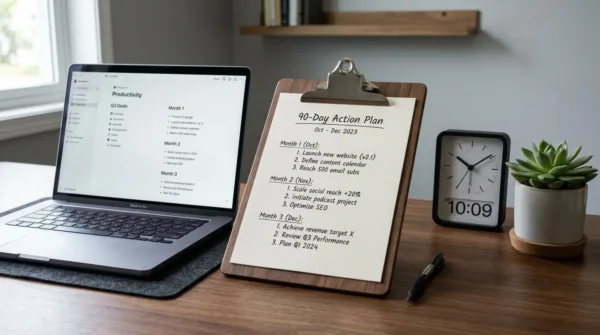
To repair a broken chart discovered during your assessment, you cannot rely on vague resolutions. Instead, deploy the clinically validated EXACT goal-setting framework. This system changes abstract desires into highly specific, trackable behavioral metrics immediately.
Explicit Focus
Your target must isolate one single, clearly defined behavior rather than a broad, ambiguous concept. Frame the goal in highly positive terms, focusing strictly on what you will actively build rather than what you want to avoid.
Exciting Motivation
The target must resonate deeply with your personal values, inspiring real enthusiasm when you visualize achieving it. If a goal feels like a dry, bureaucratic obligation, you will abandon it the moment your willpower drops.
Assessable Metrics
Every goal requires clear mathematical parameters so you can objectively verify your daily and weekly progress. Strip away all subjectivity so that your success can be easily tracked by a simple checklist.
Challenging Scope
The goal must stretch your current capabilities without breaking your spirit or causing total exhaustion. It should push you out of your comfort zone while remaining realistic relative to your current resources.
Timeframed Boundaries
You must lock in a firm, definitive deadline for completing the initial phase of your behavior change. A strict timeframe prevents endless procrastination and creates a healthy sense of personal accountability.
| Goal Component | Weak Approach | EXACT Method |
| Physical | “Get in shape soon.” | “Complete 45 minutes of weight training every Monday, Wednesday, and Friday at 7 AM.” |
| Financial | “Stop wasting money.” | “Automate a $250 transfer to my emergency savings account on the 1st of every month.” |
| Social | “Be more social.” | “Call one close friend every Sunday afternoon for a 30-minute undistracted conversation.” |
Overcoming Critical Obstacles Found in a Lifestyle Balance Check
The journey toward lifelong harmony is consistently met with structural obstacles, deeply ingrained habits, and heavy social pressure. Anticipating these specific friction points allows you to build strong defenses before they derail your progress.
Managing Boundary Pushback
When you begin enforcing healthy boundaries, people who used to benefit from your lack of boundaries may push back. Stand firm, use clear language, and understand that preserving your health is entirely non-negotiable.
Curing the Perfectionism Trap
Many people abandon their wellness plans the moment they experience a single chaotic week or missed habit. Balance is a continuous, lifelong process of course correction, not a flawless, fragile streak.
Eliminating the “Too Busy” Myth
Busyness is frequently a symptom of poor prioritization and misallocated energy rather than a genuine lack of hours. Replacing low-value digital consumption with intentional restoration reclaims hours of lost time every week.
The 90-Day Roadmap for Your Lifestyle Balance Check
True behavioral change takes time to move from conscious effort to an automatic lifestyle habit. Follow this structured 90-day execution protocol to systematically optimize your lifestyle metrics without causing burnout.
- Days 1 to 30 (The Micro-Habit Foundation): Focus entirely on your single lowest-scoring dimension from your initial check. Implement one small action that takes less than ten minutes a day to build consistent momentum.
- Days 31 to 60 (Boundary Integration): Expand your focus to your second lowest-scoring area while keeping your initial micro-habits on autopilot. Begin scripting clear, polite refusals to protect your newly reclaimed time from external demands.
- Days 61 to 90 (Full Optimization & Re-Audit): Scale your actions into larger, high-impact behavioral goals using the EXACT framework across all six pillars. On day 90, re-run the assessment to measure your growth and plan your next optimization cycle.
FAQs: Mastering Your Ultimate Lifestyle Balance Check
What is the absolute best way to launch a lifestyle balance check?
The absolute best way to launch is to complete a structured 36-question audit across all six core dimensions of wellness. Rating your current satisfaction levels honestly provides a visual map that exposes exactly where your lifestyle is currently failing.
How often must I execute a comprehensive lifestyle balance check?
You must execute a formal lifestyle balance check every 90 days to catch sudden boundary erosion before it triggers severe burnout. This quarterly rhythm allows you to adapt your habits to major career shifts and changing personal priorities smoothly.
Can one single failing score ruin my entire lifestyle balance check?
Yes, because the six dimensions are deeply interconnected, meaning a massive deficit in one area creates toxic friction across the rest. For instance, extreme financial strain or poor physical health will rapidly destroy your emotional resilience.
What should I do if my lifestyle balance check reveals a spiky layout?
Do not panic or attempt to fix everything at once, as that road always leads to total exhaustion. Instead, isolate your single lowest-scoring dimension from the check and deploy one tiny, 10-minute micro-habit to establish steady momentum.
How do I protect my parameters after finishing a lifestyle balance check?
You must use clear, polite, and uncompromising language to decline low-value demands on your time. Realize that protecting your mental peace is non-negotiable and that establishing firm limits is essential for your long-term health.