AI search is changing how people discover brands, products, and information, but traditional SEO tools don’t show the full picture. If your brand appears in ChatGPT, Google AI Overviews, Perplexity, or other AI answers, you need to know when it appears, what it says, and which sources influence the response. This shift reflects the future of AI-powered search, where businesses need to understand not just rankings, but how AI systems discover and present information.
The best AI search monitoring tools help you track brand mentions, citations, competitors, visibility, sentiment, and AI search performance in one place. This guide compares the leading tools so you can identify the right option for your goals, budget, and AI search strategy.
What Are AI Search Monitoring Tools?
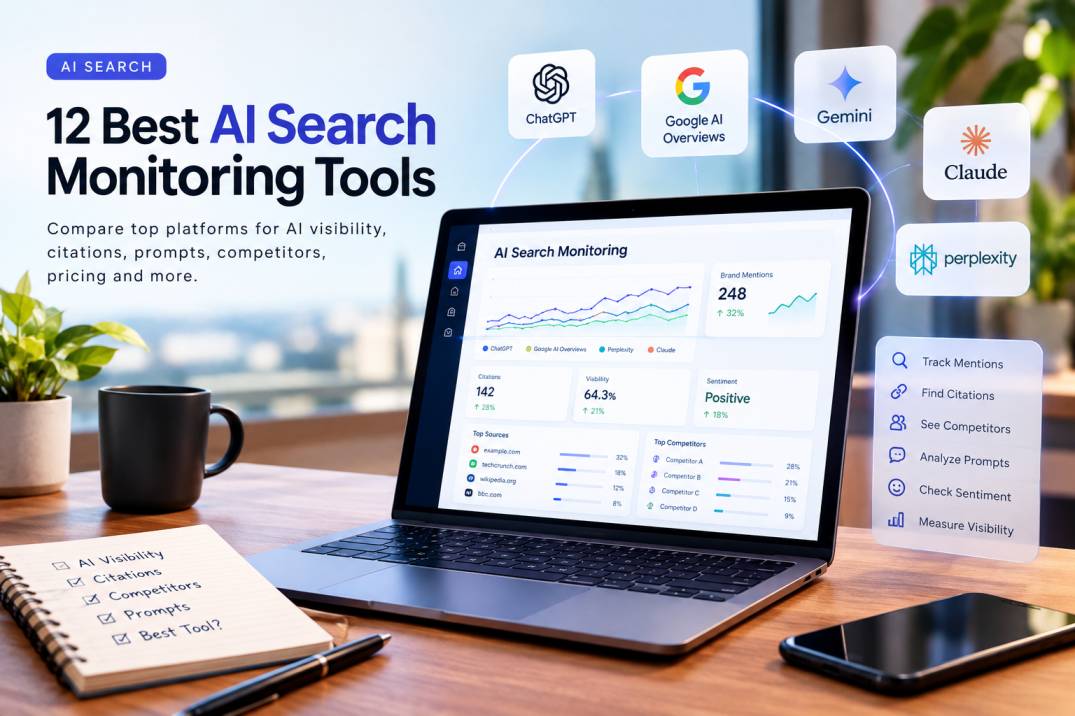
AI search monitoring tools track how brands appear in AI-powered search results from platforms like ChatGPT, Google AI Overviews, Perplexity, Gemini, and Claude. They show when and where a brand is mentioned, its visibility and position, and how it compares with competitors.
These tools also monitor the prompts behind AI answers, citations, source websites, share of voice, and sentiment. This helps businesses understand how AI search represents their brand and identify opportunities to improve visibility and citations.
Best 12 AI Search Monitoring Tools Compared
These 12 AI search monitoring tools cover different needs, from tracking brand mentions and citations to analyzing competitors, prompts, sentiment, and AI visibility. The right choice depends on your SEO workflow, business size, required AI platforms, and how deeply you want to turn monitoring data into action.
1. Semrush AI Visibility Toolkit Best for SEO
Semrush combines AI visibility monitoring with its broader SEO platform, making it useful for teams that want to manage traditional search and AI search from one place. It tracks AI mentions, citations, visibility, competitors, prompts, and sentiment across major AI search experiences.
Best for: SEO teams and businesses already using Semrush.
AI engines: ChatGPT, Google AI Overviews, and other major AI search experiences supported by the toolkit.
What it tracks: AI mentions, citations and cited sources, visibility, competitor performance, prompts, and sentiment.
SEO integration: A major advantage is the connection between AI visibility data and traditional SEO research, allowing teams to move from AI-search insights to keyword, content, and competitor analysis.
Technical readiness: Semrush also provides insights that help identify whether a site is prepared for AI search and visibility.
Pricing: Available as part of Semrush’s paid platform/toolkit plans, with pricing depending on the selected plan and usage.
Limitations: It can be more than smaller teams need if they only want simple AI mention monitoring, and some advanced capabilities depend on the plan.
Best user: SEO professionals, agencies, and businesses that want AI search monitoring alongside their existing SEO workflow.
2. Frase
Frase stands out by connecting AI visibility monitoring with the actions needed to improve it. It tracks AI mentions, citations, and competitor visibility, then helps identify content gaps through research and content analysis. Teams can use those insights to optimize, write, and publish content, creating a practical monitor → fix workflow. This makes AI visibility monitoring part of a modern digital workspace, rather than a standalone reporting task.
Its main limitation is that it is better suited to teams wanting monitoring combined with content optimization rather than a purely dedicated AI visibility platform.
3. Profound
Profound is built for organizations that need large-scale AI visibility data. It uses browser-level queries to monitor AI conversations across a wide range of prompts, markets, and use cases, including global visibility and AI shopping experiences.
It also provides reporting and conversation-level insights for enterprise teams. The main limitation is that its scale and enterprise focus can make it less suitable for smaller businesses with basic monitoring needs.
4. Peec AI
Peec AI is particularly useful when you want to understand where AI answers get their information. It tracks citation rate, cited domains, URLs, content formats, competitor sources, and prompt-level source patterns, helping teams identify which pages and sources influence AI responses.
Its source analysis can reveal content gaps and potential partnership opportunities, while agency features and Looker Studio support make reporting easier across clients. The main limitation is that its strongest value is source and citation analysis rather than a complete SEO workflow.
5. Scrunch
Scrunch focuses on turning AI visibility data into practical GEO opportunities. It identifies content gaps, outreach opportunities, low-hanging wins, and visibility patterns across personas, topics, and buying stages. It also combines technical audits with AI referral traffic and conversion data.
Its Agent Experience Platform (AXP) adds another layer by helping websites become more accessible and useful to AI agents. The limitation is that its broader feature set may be more than teams need if they only want basic AI visibility tracking.
6. Conductor
Conductor brings traditional SEO and AI search monitoring together for enterprise teams. Along with AEO and AI visibility, it connects search data with sources such as Google Search Console and Google Analytics, while supporting API-based workflows and broader enterprise reporting.
This makes it useful for organizations managing SEO and AI search at scale. However, its enterprise orientation can make it less practical for smaller teams looking for a lightweight monitoring solution.
7. Promptwatch
Promptwatch connects AI search monitoring directly with content opportunities. It can use Google Search Console data to generate relevant prompts, track AI responses, analyze content gaps, and map existing pages against the answers where they appear, or where they are missing.
Beyond monitoring, it covers off-site mentions, Actions, Agent Chat, and a Content Agent, with API, MCP, and CMS publishing capabilities supporting a more complete prompt → insight → content workflow. Its limitation is that teams looking only for simple visibility reporting may not need its broader content-focused feature set.
8. Rankscale
Rankscale tracks AI visibility across 17+ engines and lets users drill down from the prompt to the AI response and its citations. It also supports monitoring across 240+ regions, making it useful for brands targeting multiple markets.
A key differentiator is its combination of organic AI visibility with AI ads and commerce insights. It also supports prompt decoding, MCP, API access, Data Studio, and white-label reporting. This makes Rankscale particularly useful for agencies and teams that need detailed, scalable AI search reporting.
9. OtterlyAI
OtterlyAI focuses on tracking brand mentions, citations, sentiment, competitors, and search intent across AI platforms. It also provides actual screenshots of AI interfaces, giving teams direct evidence of how their brand appears rather than relying only on aggregated metrics.
Its GEO audit adds another layer by identifying potential visibility issues and optimization opportunities. OtterlyAI is a practical option for teams that want straightforward AI monitoring, although its capabilities are more focused on visibility tracking than a full SEO and content workflow.
10. SE Ranking
SE Ranking combines AI search monitoring with its existing SEO platform, allowing teams to track visibility across Google AI Overviews, AI Mode, and chatbot-based search alongside traditional SEO performance.
It also supports competitor visibility tracking and reporting, making it easier to compare AI and organic search performance in one workflow. Its main limitation is that teams looking for highly specialized AI research or deeper AI-source analysis may need a more dedicated platform.
11. Writesonic
Writesonic combines AI visibility monitoring with content optimization, tracking brand mentions, citations, sentiment, and competitor performance while also providing AI crawler analytics. It extends this into AI Shopping and content optimization, giving teams a way to connect visibility insights with content improvements.
Its broader enterprise capabilities make it suitable for organizations managing AI search and content at scale. However, users focused primarily on citation intelligence or technical AI monitoring may find more specialized tools better suited to those needs.
12. Wellows
Wellows differentiates itself by using Google Search Console data to help generate tracking queries, giving AI monitoring a connection to real search behavior rather than relying entirely on synthetic prompts. It can then monitor AI responses, competitor gaps, sentiment, and potential content and outreach opportunities.
This approach makes Wellows useful for SEO teams that want AI visibility insights grounded in their existing search data. Its main limitation is that teams needing advanced enterprise-scale AI analytics or broader platform capabilities may prefer a more specialized solution.
How We Evaluated the Best AI Search Monitoring Tools
- AI Platform Coverage: Coverage across major AI search engines and answer platforms.
- Prompt & Visibility Tracking: Prompt coverage, brand mentions, visibility, position, sentiment, and competitor performance.
- Citation & Source Analysis: Cited URLs, domains, sources, and the content influencing AI responses.
- Data Quality & Accuracy: Data collection methods, including APIs, browser-level queries, UI scraping, and real or synthetic prompts.
- Actionability & Integrations: Content, SEO, technical, reporting, traffic, and optimization capabilities beyond basic monitoring.
AI Search Monitoring Tools Comparison
| Tool | Best For | AI Engines | Key Features | Starting Price |
| Semrush | SEO + AI Search | Multiple | Visibility, prompts, citations, sentiment, competitors | Paid |
| Frase | Monitor-to-Fix | Multiple | Monitoring, content gaps, optimization, writing | Paid |
| Profound | Enterprise | Multiple | Browser queries, large-scale prompts, shopping, reporting | Enterprise |
| Peec AI | Citation Analysis | Multiple | Citations, sources, competitors, agency reporting | Paid |
| Scrunch | GEO Insights | Multiple | Content gaps, technical audits, AI traffic, conversions | Paid |
| Conductor | Enterprise SEO + AI | Multiple | SEO, AEO, GSC, GA4, AI crawler activity | Enterprise |
| Promptwatch | Prompt-to-Content | Multiple | GSC prompts, content gaps, AI responses, CMS | Paid |
| Rankscale | AI Search Reporting | 17+ | Prompt drill-down, regions, ads, commerce, MCP | Paid |
| OtterlyAI | AI Monitoring | Multiple | Mentions, citations, sentiment, screenshots, GEO audit | Paid |
| SE Ranking | SEO + AI | Multiple | AI Overviews, AI Mode, chatbot monitoring, reporting | Paid |
| Writesonic | AI + Content | Multiple | Mentions, citations, sentiment, AI Shopping, optimization | Paid |
| Wellows | GSC-Informed Monitoring | Multiple | GSC data, prompts, competitor gaps, content opportunities | Paid |
5 Common Mistakes When Using AI Search Monitoring Tools
1. Tracking Too Many or Irrelevant Prompts
A large prompt list does not automatically produce better insights. Focus on prompts that match your target audience, products, services, and search intent so the data reflects meaningful AI visibility.
2. Treating AI Visibility Like Google Rankings
AI answers are less predictable than traditional search rankings and can change based on the model, location, query wording, and context. A visibility score should be treated as a trend or signal, not a fixed ranking position.
3. Ignoring Citations and Competitors
A brand mention alone does not explain why it appears in an AI answer. Reviewing cited sources and competitor visibility shows which websites, pages, and brands are influencing the response, and where content gaps exist.
4. Ignoring Technical Crawlability and Context
If AI crawlers cannot access or understand important pages, improving the content alone may not be enough. Technical accessibility, brand accuracy, sentiment, and the context of mentions all matter when evaluating AI visibility.
5. Choosing Features Over Actionability
More AI engines or features do not necessarily make a tool better. The right platform should turn monitoring data into useful actions, such as content improvements, technical fixes, competitor opportunities, or measurable traffic and conversion insights.
Frequently Asked Questions
What is AI visibility tracking?
AI visibility tracking measures how often and how prominently a brand appears in AI-generated answers. It can include mentions, citations, sentiment, competitors, and the sources AI systems use to build their responses.
Can AI search monitoring tools track ChatGPT?
Yes. Many AI search monitoring platforms can track brand visibility in ChatGPT by testing relevant prompts and analyzing the resulting answers, mentions, and citations. The exact level of ChatGPT coverage varies by tool.
Can they track Google AI Overviews?
Yes. Several tools monitor Google AI Overviews and, in some cases, AI Mode. This helps businesses understand whether their content or brand is being surfaced in Google’s AI-generated search experiences.
Can AI visibility tools track citations?
Yes. Citation tracking shows which websites and URLs AI systems reference in their answers. This is useful for identifying the content, publishers, and sources that influence AI responses and discovering opportunities to earn more citations.
Are AI visibility scores accurate?
AI visibility scores are useful for measuring trends, but they should not be treated like fixed Google rankings. AI responses can change based on prompts, location, personalization, model updates, and data collection methods, so scores are best used for comparison and ongoing monitoring.
Do AI monitoring tools use real user prompts?
Some tools can incorporate real search or user-behavior data, while others rely mainly on manually created or AI-generated prompts. Tools that connect with sources such as Google Search Console can make tracking queries more closely aligned with actual search behavior.
Do traditional SEO tools track AI visibility?
Some traditional SEO platforms have added AI visibility features, but their depth varies. Platforms such as Semrush and SE Ranking combine traditional SEO data with AI search monitoring, while dedicated tools may provide deeper prompt, citation, or AI-response analysis.