
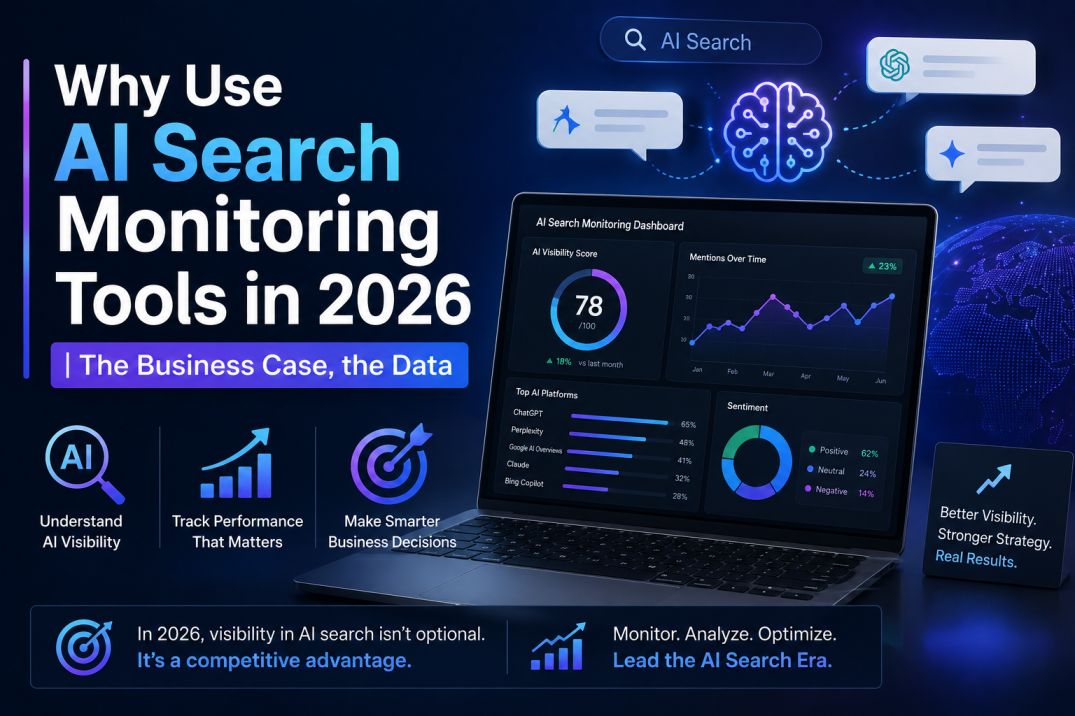
60% of Google searches now end with no click. AI Overviews answer your buyers’ questions before they ever scroll past the first screen. ChatGPT recommends your competitor instead of you. And your Google Analytics? It shows none of it.
Welcome to the blind spot.
This isn’t a futuristic concern. It’s a present-tense one, and the data is stacking up. AI-generated answers already account for 8.2% of search traffic, and that number is growing at more than 150% year over year. Meanwhile, researchers are converging on a striking number: AI-originated traffic converts at roughly 4–5× the rate of traditional organic clicks.
By 2026, the question is no longer whether your business is being impacted by AI search. The question is whether you can see it at all.
That’s the entire point of AI search monitoring tools — a fast-emerging category that sits somewhere between analytics, SEO, and digital PR, and closes the gap your current stack can’t.
So, why use AI search monitoring tools? Here’s the straight answer, then the full breakdown.
AI search monitoring tools track, measure, and improve how AI assistants (ChatGPT, Perplexity, Gemini, AI Overviews) see and cite your brand. The business case is simple: your existing analytics are blind to AI traffic, AI clicks convert 4–5× better than organic, citation slots are finite, and every month you wait, a competitor builds the presence you should be claiming.
Let’s unpack the five core reasons, what happens if you don’t act, the framework that tells you exactly what to measure, and a 30-day playbook you can start this week.
Interested in More tech content? Go to to XX British to read more valuable real world articles.
Reason 1: Your Current Tools Are Blind to AI Traffic
The single most underrated reason to adopt AI search monitoring is that your existing analytics stack simply cannot see this channel.
GA4 shows you sessions, sources, and conversions — but it has no concept of a user who got their answer from an AI Overview and never clicked through, or who clicked a ChatGPT citation instead of a blue link. Google Search Console tracks queries on Google. It has no data on what happens in Perplexity or Gemini.
Here’s the uncomfortable truth that should reframe your whole strategy: roughly 80% of AI citations come from sources that aren’t even in Google’s top 10. That means ranking #1 on Google tells you almost nothing about whether you’ll be recommended by an AI assistant. You can be first on the SERP and entirely absent from the answer.
The “blue link” mental model that drove SEO for two decades is broken. You can no longer measure your discoverability with ranking tools alone — because the ranking isn’t where the visibility happens anymore.
This is the reason the category exists at all: you can’t optimize what you can’t measure.
Reason 2: AI Traffic Converts 4–5× Better Than Organic
This is the data that turns AI monitoring from a “nice to have” into a core budget line. The conversion quality of AI-originated traffic is genuinely staggering, and multiple independent sources are landing on the same conclusion.
Let’s look at the numbers:
| Source | AI Traffic Conversion | Traditional Conversion |
|---|---|---|
| ThoughtMetric (e-commerce) | 6.7% | 3.9% |
| Superprompt (12M visits analyzed) | 14.2% | 2.8% |
| Ahrefs | 12.1% | baseline |
The engagement metrics tell a similar story, and this is where the “conversion quality paradox” lives. Visitors who arrive via AI:
- View 2.3 pages on average, versus 1.2 for organic users
- Spend 5:18 on the page, versus 1:24
- Are dramatically more likely to convert, subscribe, or book
Why? Because of the “pre-sold” effect. By the time someone clicks a citation in ChatGPT or Perplexity, they’ve already had their question paraphrased, context summarized, and options narrowed to a handful of sources. They arrive informed, primed, and with the conversational “cold open” already handled. The AI has done your top-of-funnel work for you — you just have to close the deal.
📊 Think about it in paid-search terms: if a paid channel delivered a 12% conversion rate at this volume, you would scale that budget immediately. AI search is delivering that caliber of intent — entirely unmonitored, and essentially free at the source.
That’s the Conversion Quality Paradox: the highest-intent traffic you’re not measuring is likely one of the highest-ROI channels you’re not funding.
Reason 3: Citation Slots Are Finite — And Hard to Displace
Here’s a structural reality that many teams miss until it’s too late: AI assistants cite a limited number of sources per answer. ChatGPT typically references between 5 and 7 sources when it responds to a fact-based or recommendation query.
That means there is a hard ceiling on how many brands can be “visible” for a given prompt. When the answer to “best [category] software” is generated, only a handful of companies make the cut.
The slots aren’t randomly allocated. They go to brands that have built established, consistent credibility — repeated mentions across trusted sources, a track record of being referenced, and the kind of reinforcement that accumulates over time. This is downstream of your digital PR, your reviews, your community presence, and yes — your years of brand building.
And critically: displacing an incumbent is hard. If a competitor is already being cited consistently for a cluster of buyer prompts, they have a structural advantage that compounds. You’re not just competing for attention; you’re competing to displace entrenched citations.
The window to claim those positions before your competitors do is closing, and it’s not going to reopen.
Reason 4: You Can’t Optimize What You Can’t Measure
Look, keyword rankings were never a perfect proxy for revenue — but at least they were a feedback loop. You’d see a drop, investigate, adjust, and recover.
With AI search, that feedback loop doesn’t exist by default. Consider:
- You can rank #1 on Google and be completely absent from ChatGPT for the same query.
- Downranking on Google gives you a signal. No citation in an AI answer gives you no signal at all — you just quietly vanish.
- Without measurement, you have no way to know if your content improvements, PR wins, or brand changes are moving the needle in AI responses.
Monitoring creates the feedback loop. You see which prompts you’re absent from, what your share of voice is against competitors, and whether your optimization efforts actually shift the AI’s behavior. Without it, you’re flying blind and calling it “strategy.”
Reason 5: The Cost of Waiting Compounds
This is the section most guides skip, and it’s the one that should worry you most.
Every month you wait has a compounding cost, because brand mentions accumulate in AI training data and model behavior. The references, citations, and associations that build up now become part of how AI assistants “know” your brand tomorrow. They’re not ephemeral — they bake in.
- Month 1: You do nothing. Your competitor runs a PR push, gets cited in a few authoritative sources, starts appearing for buyer prompts.
- Month 6: Your competitor has a consistent citation presence. You’re absent. Their AI share of voice is growing.
- Month 12: They’ve become the “safe” recommendation. The spots are claimed. You’re now trying to displace an entrenched incumbent — a far harder, more expensive task than claiming the slot when it was open.
Late movers don’t just miss out; they play catch-up into a system that rewards being early. The compounding is the reason this is a “now” problem and not a “next quarter” problem.
The Cost of Inaction: A Calculator-Style Breakdown
Let’s make this concrete with real math. If AI search represents a growing slice of your addressable traffic, the money at stake is quantifiable.
Here’s a worked example for a mid-size SaaS company:
- Step 1: Assume your organic/SEO channel drives $10M in annual revenue.
- Step 2: AI already accounts for roughly 8.2% of search traffic. Even conservatively, that’s a meaningful share.
- Step 3: If you capture 0% of that 8.2% — which is exactly what happens if you’re not cited — you’re leaving the full value on the table.
- Step 4: $10M × 8.2% = $820,000 at stake.
- Step 5: Even capturing a competitive 25% share of that = $205,000 per year.
Now the scary part: compounding over 3 years. Because citation presence builds on itself and late movers play catch-up, the cumulative cost of inaction for a mid-size SaaS company can easily reach $1–2 million or more across that window, not counting the widening gap to competitors who started early.
The exact figures shift with your business, but the direction never does. Whether you’re a $1M or $50M in ARR, the principle holds: a growing, high-converting channel you can’t see is costing you real revenue every single quarter.
The 5-Metric Monitoring Framework
To avoid the mistake of treating AI monitoring as one vague goal, here’s a clear framework for what actually gets measured. This is what separates a real monitoring practice from a dashboard that looks busy and says nothing.
| Metric | Definition | Why It Matters |
|---|---|---|
| Mention | Your brand name appears in an AI response | The strongest driver of visibility and awareness |
| Citation | The AI points to a URL you control | Direct referral traffic + authority transfer |
| Share of Voice | Your mentions vs. your named competitors | Competitive positioning over time |
| Sentiment / Positioning | How the AI describes your brand | Directly shapes whether you get recommended |
| Prompt Gap | Buyer queries where you’re totally absent | Your content opportunity map |
The magic is in how they work together. Mentions tell you if you’re seen. Citations tell you if you’re actionable. Share of voice tells you if you’re winning. Sentiment tells you if people are being told good things. And prompt gaps tell you exactly where to create content next.
If you only track one metric, track share of voice — it’s the closest thing to a single number that tells you where you stand.
The 4-Phase Monitoring Maturity Model
Different teams need different levels of sophistication. Here’s the model that helps you figure out where you are and what’s actually worth investing in.
Phase 1: Manual (one-shot checks)
You run a handful of brand-related prompts by hand and eyeball the answers. Note them in a spreadsheet. Pros: free, fast. Cons: unsustainable, no trends, easy to forget.
Phase 2: Tracked (weekly logs)
You lock a set of prompts and run them on a fixed schedule. You start building a time-series of how responses change. Pros: you see trends. Cons: manual effort, still a slice of the picture.
Phase 3: Automated (real-time)
Dedicated tools continuously monitor your prompts across ChatGPT, Perplexity, Gemini, and AI Overviews. They track share of voice, alert you to changes, and benchmark competitors. Tools: Profound, Otterly AI, HubSpot’s AEO suite, and others. Pros: persistent, scalable, alert-driven.
Phase 4: Optimized (closed-loop)
Monitoring feeds directly into a cycle: monitor → extract insight → create/optimize content → re-measure. It’s tied to revenue outcomes, and it’s cross-functional — SEO, content, and digital PR all work off the same signals. Pros: this is where the ROI really compounds.
📊 Where is your team? If you’re in Phase 1–2, you’re at least seeing the gap. If you’re still at zero, you’re not competitors in the AI search game at all — you’re an audience.
The Conversion Quality Paradox (Deep Dive)
Let’s expand on the idea I flagged earlier, because it’s the single most persuasive argument for funding this channel.
The pre-sold effect is the engine behind the high conversion rates. When a user lands on your site from an AI citation, they are not a cold visitor. In the span of a conversation, the AI summarized the landscape, narrowed the options, and positioned you favorably enough to earn the click. That’s the equivalent of a warm intro, delivered at scale.
Compare it to paid search economics. You spend money bidding on keywords to rent attention that AI assists deliver for free as a side effect of being credible. And yet, the channel delivering the better-quality traffic is the one nobody’s measuring.
This is the paradox: your highest-ROI channel is your least-monitored one. Every other high-converting channel gets a budget, a dashboard, and a weekly review. AI search gets nothing — except the users, who keep arriving, converting, and never telling you how they got there.
How AI Decides What to Cite (The Mechanics)
To optimize for AI visibility, you need to know what the AI is looking for. Here’s the mechanics.
AI assistants weigh four core signals when deciding what to reference:
- Mentions — how often your brand appears across the web
- Citations — how often authoritative sources point to you
- Recommendations — how often you’re suggested by reviewers, communities, and peers
- Sentiment — the tone in which people describe you
There’s a striking data point that gives this real weight: research cited by Search Engine Land found that only 7.2% of domains are cited across both major LLMs and AI Overviews. The overlap between being an “answer” in one AI and being an “answer” in another is tiny. That means surface-specific optimization matters — you can’t assume one assistant’s behavior tells you anything about another’s.
Reddit and Wikipedia carry particular weight across virtually all AI assistants. They’re treated as high-trust, human-sourced knowledge bases. If your brand shows up in the right subreddits or is referenced on Wikipedia, that’s a strong signal. Many teams overlook this entirely — and it’s an under-optimized lever.
At the heart of it all is frequency and consistency across trusted sources. AI models synthesize what they see repeated, consistently, positively, from sources they trust. This is why it compounds: every genuine mention, review, and authoritative citation reinforces the others.
The most important takeaway: this isn’t a one-month content push. It’s years of brand reinforcement — which is exactly why the early movers hold the advantage.
First 30 Days: Your Implementation Playbook
Enough theory. Here’s how to actually start, week by week.
Week 1 — Audit
Run 20–30 brand-relevant prompts across ChatGPT, Perplexity, and Gemini. For each, note: who gets cited, who’s absent, and how your competitors are positioned. Document your baseline so you have something to measure against.
Week 2 — Competitor mapping
Identify your 3–5 key competitors. Compare each one’s share of voice against yours. Flag the prompt gaps — the buyer queries where you’re completely missing. This is your earliest and highest-value content opportunity map.
Week 3 — Tool selection
Decide manual vs. automated. Be honest about your capacity. The range is real: $0 for a DIY spreadsheet approach, up to $500–$5K/month for enterprise platforms. Match the tool to your phase — don’t buy Phase 4 software if you’re a Phase 2 team.
Week 4 — Cadence
Set your monitoring schedule. Weekly logs, monthly share-of-voice report, stakeholder briefing. Crucially, tie it to revenue KPIs — otherwise it’s just a curiosity and it’ll get defunded at the first budget review.
That’s a full first month. You’ll end it with a baseline, a gap map, a chosen tool, and a reporting rhythm — which is more than most teams have after a year.
What to Look for in a Tool (Buyer’s Guide)
Not all AI search monitoring tools are equal. Here’s the evaluation checklist for choosing one.
Non-negotiable capabilities:
- Multi-surface coverage — ChatGPT, Perplexity, Gemini, and AI Overviews (a tool that only tracks one surface is half a tool)
- Time-series tracking — so you can see trends, not snapshots
- Share of voice calculation — benchmarking against named competitors
- Prompt gap analysis — surfacing the queries where you’re absent
- Competitor benchmarking — see how your positioning stacks up over time
Strongly desirable:
- Sentiment analysis (how you’re described, not just if you’re mentioned)
- Alerting (get notified when your visibility shifts)
- Reporting and export (for stakeholder buy-in)
- API access (for building it into your own dashboards)
Nice to have:
- Pricing tiers that scale with team size
- Integration with your existing analytics/SEO stack
Notably, this is a distinction your traditional SEO tool can’t cover. AI monitoring is a different discipline from keyword ranking. You’ll likely run both — the SEO tool for blue-link performance, the AI monitoring tool for the new channel.
Tools to compare: Profound, Otterly AI, HubSpot’s AEO suite, Atomic AI, Semrush’s AIO, Infinisynapse’s SEO Health, and others.
⚠️ Transparency note: This article may reference tools we evaluate or partner with. We disclose any vendor relationships clearly and never let them skew the guidance — the aim is an honest buying framework, not a sponsored ranking.
FAQ: AI Search Monitoring Tools
What are AI search monitoring tools?
They’re platforms that track how AI assistants — ChatGPT, Perplexity, Gemini, and AI Overviews — see and cite your brand. They measure mentions, citations, share of voice, sentiment, and prompt gaps, so you can optimize for a channel your standard analytics can’t see.
Do I really need one?
If your buyers ask an AI assistant for recommendations in your category, yes. If you have named competitors and want visibility in this growing channel, you’re already behind if you’re not measuring. If nobody researches products in your space, you can wait.
How much do they cost?
It ranges from $0 (DIY manual tracking) to about $500–$5,000/month for enterprise platforms. Most teams find the mid-tier tools land in the $100–$500/month range and deliver a strong return given AI traffic’s high conversion rate.
What’s the ROI?
The math is compelling: if AI accounts for 8.2% of search traffic and converts 4–5× better than organic, even a 25% share of that channel can represent significant annual revenue. For a $10M organic channel, that’s roughly $205K/year just for one competitive share.
How is this different from my SEO tools?
SEO tools track Google keyword rankings and blue-link clicks. AI monitoring tracks AI recommendation behavior across multiple assistants and surfaces. They’re complementary disciplines, not replacements — you need both.
Can I do it manually?
Yes, in Phase 1–2. Running a locked set of prompts on a weekly schedule in a spreadsheet can get you started for free. But it’s unscalable and won’t catch real-time shifts or handle multi-surface tracking — which is where automation earns its keep.
Which tool is best for small teams?
Look for a mid-tier tool with a free trial or low entry price, multi-surface coverage, and simple share-of-voice reporting. You can scale up to a more sophisticated platform once you’ve validated the channel and built a monitoring habit.
Which tool is best for enterprise?
Prioritize tools with API access, enterprise-grade reporting, cross-surface benchmarking, alerting, and robust data governance. Match the platform to your internal stakeholders’ reporting needs — the tool needs to fit your analytics workflow, not just look impressive.
Will Google Analytics ever catch up?
Possibly, but it’s not a reason to wait. GA4 is fundamentally built around sessions and sources that AI referral behavior doesn’t map cleanly onto. A dedicated monitoring layer is the right tool for this job today.
How fast is AI search growing?
Fast. AI-generated answers went from essentially zero to ~8.2% of search traffic by mid-2025, growing more than 150% year over year. Some forecasts put AI Overview disruption in the double digits of overall search volume within a couple of years.
Conclusion
AI search isn’t coming. It’s here a, d your analytics can’t see it, your buyers are already using it, and your competitors are quietly building the citation presence you should be claiming.
The question was never whether to monitor. It’s whether you’ll claim those finite citation slots now — while the window is still open or pay to play catch-up for the next 24 months against entrenched incumbents.