
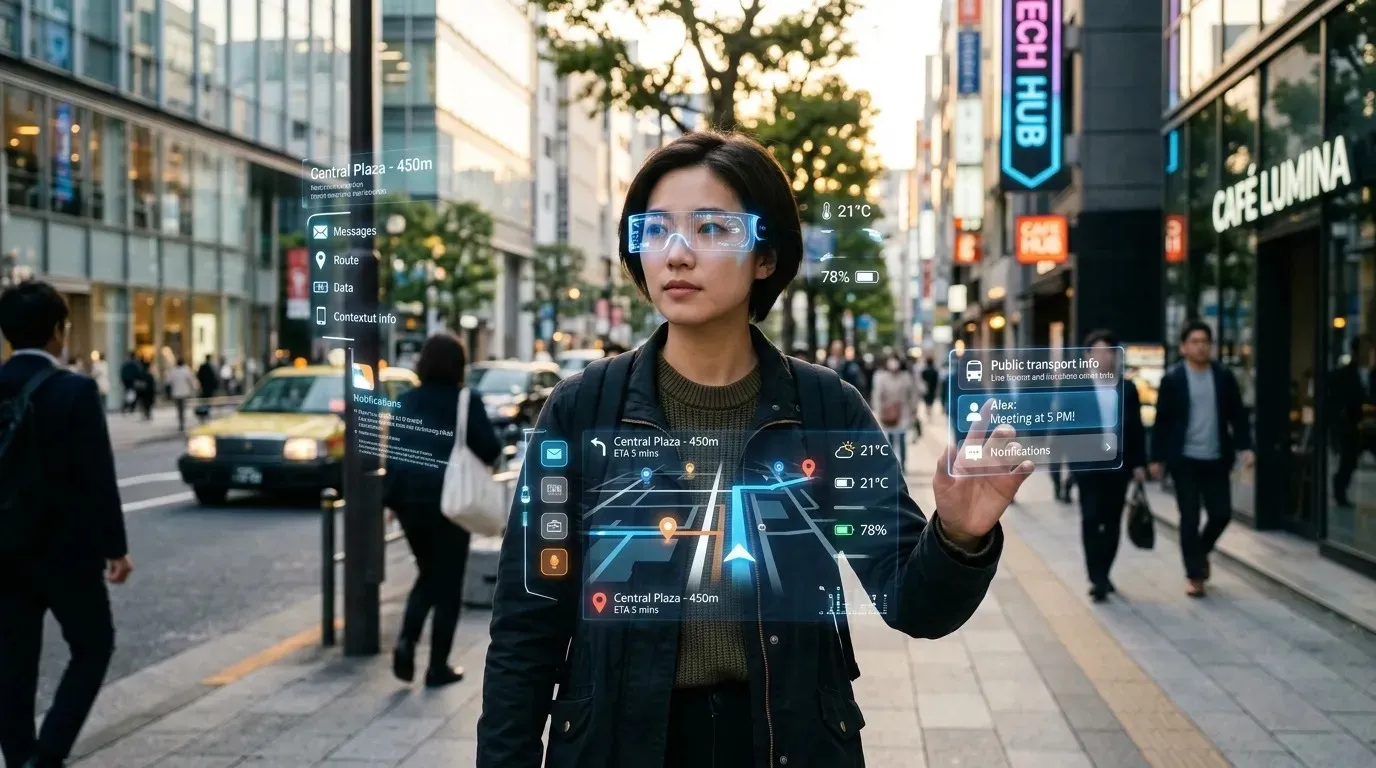
Repetitive hardware incremental updates have officially reached a massive dead end across the global tech ecosystem. The modern smartphone market is completely saturated, leaving consumers uninspired by minor camera refinements or slightly faster silicon chips. Because of this massive technological plateau, the world’s most powerful enterprises are aggressively pivoting toward an entirely new computational paradigm. Globally, over $150 Billion is being funneled into uncharted tech frontiers as leading platform architects prepare for the next massive gold rush.
This monumental transition is not merely about launching another expensive lifestyle gadget to sit inside your pocket alongside your keys. Instead, it marks the definitive end of the two-dimensional rectangular glass interface that has dominated human focus for nearly two decades. The race to define what replaces the mobile screen is the most high-stakes battle in modern industrial history. Whoever wins this platform war will completely control the software architecture, digital advertising networks, and global commerce infrastructure for the next thirty years.
As these massive conglomerates shift their resources, a critical phrase has begun dominating Silicon Valley boardrooms and engineering labs. There is a definitive, data-backed reason why tech giants envision a future beyond smartphones with such immense financial urgency. They are creating an ecosystem where computers adapt to human biology rather than forcing humans to hunch over glass panes. This comprehensive investigation breaks down the hidden strategies, structural hardware innovations, and competitive roadmaps shaping the post-smartphone world.
The Screen Bottleneck and the Rise of Ambient Computing
Humans are inherently three-dimensional physical entities, yet we voluntarily lock our digital lives inside a static two-dimensional glass rectangle. This fundamental mismatch has created an epidemic of physical fatigue, poor posture metrics, and severe digital isolation across global user bases. The smartphone has evolved from a tool of absolute liberation into a rigid physical bottleneck that limits human productivity. To break past this sensory limitation, engineers are completely redesigning how data is layered over our actual physical environments.
This philosophical evolution has paved the absolute path for what computer scientists refer to as ambient computing intelligence. In this upcoming framework, the machine is no longer a distinct object you pick up, unlock, and stare into continuously. Instead, processing power is distributed seamlessly across your surrounding environment, remaining completely invisible until explicitly summoned by your voice or gaze. This structural transition means apps will transform into fluid, context-aware digital assistance layers that actively predict your operational workflow.
Interface designs are shifting rapidly away from physical touch grids and toward intuitive, biologically driven inputs that require zero manual effort. When we analyze why tech giants envision a future beyond smartphones, we see a clear desire to capture human attention through natural biology. Digital interactions will soon be executed via micro-gestures, subtle voice modulations, and instantaneous eye tracking systems. By removing the physical barrier of a glass screen, technology becomes an invisible extension of human intent.
Meta and the Multi-Billion Dollar Holographic AR Glasses Bet
Mark Zuckerberg has made the most aggressive and financially volatile bet on the post-smartphone era through his Reality Labs infrastructure. Meta has already burned past $50 Billion in capital expenditures with the singular goal of owning the definitive augmented reality pipeline. Zuckerberg firmly believes that lightweight smart glasses featuring true holographic displays will completely dismantle the mobile carrier ecosystem. By controlling the hardware layer, Meta aims to free itself from the strict operating system rules imposed by Apple and Google.
The foundational thesis behind this massive engineering project is to turn the entire physical world into a dynamic digital canvas. Instead of pulling out a phone to check notifications or maps, information is projected directly into your field of view. This creates a continuous, uninterrupted stream of context-aware data that blends perfectly with your immediate physical surroundings. The ultimate goal is to make digital architecture feel as authentic and structurally real as actual physical furniture.
The commercial execution of this strategy is already visible through the massive success of the Ray-Ban Meta smart glasses. These stylish frames have proven that everyday users are highly willing to adopt facial wearables if they remain lightweight and fashionable. Meanwhile, Meta’s ultra-advanced holographic prototype, known internally as Orion, represents the absolute pinnacle of their long-term structural hardware roadmap. This device proves that true spatial overlays can be achieved without bulky headsets.
Apple and the Premium Spatial Computing Ecosystem Shift

Apple approaches the post-screen frontier from a position of absolute ecosystem dominance, choosing to label this transition as Spatial Computing. Rather than trying to rush unrefined smart glasses to market, Tim Cook’s team has engineered an incredibly powerful mixed-reality foundation. The strategy focuses on establishing an elite, uncompromising hardware benchmark before shrinking the technology into everyday consumer eyewear profiles. This ensures that developers can build incredibly sophisticated software frameworks long before mainstream adoption hits.
The primary manifestation of this calculated architectural roadmap is the incredibly advanced Apple Vision Pro computing platform. This device effectively transforms your entire room into an infinite, high-resolution digital desktop monitor system. It utilizes ultra-low latency passthrough cameras alongside micro-OLED displays to merge digital assets perfectly with physical reality. Removing the physical boundaries of a screen, it alters how humans conceptualize computing real estate.
To ensure this framework scales globally, Apple is relying on its ultra-powerful proprietary custom M-series silicon processing architecture. These chips allow the device to execute complex spatial audio, eye tracking, and hand gestures simultaneously with zero thermal throttling. Furthermore, the integration of on-device Apple Intelligence ensures that the system understands your physical environment in real time. This deep technological foundation lays the groundwork for the upcoming lightweight Apple Glass ecosystem.
Google and the Open Infrastructure of Android XR Development
Google’s overarching strategy for the post-mobile world focuses heavily on software infrastructure, cloud architecture, and open operating platforms. Just as Android successfully democratized the mobile landscape, Google intends to build the definitive software foundation for next-generation spatial wearables. They recognize that while building bespoke hardware is incredibly expensive, controlling the primary operating software guarantees infinite advertising real estate. This architecture is being designed under a specialized ecosystem known globally as Android XR.
This software framework is engineered to run seamlessly across hardware built by diverse third-party manufacturing partners like Samsung and Sony. By providing a turn-key spatial operating system, Google ensures it remains the primary search and data layer of the world. This prevents hardware competitors from locking Google out of the lucrative spatial advertising and application distribution markets. The focus is to build an open matrix where every device talks to the cloud.
At the absolute center of this ambient intelligence roadmap sits Project Astra, Google’s advanced real-time multimodal AI vision engine. Project Astra can actively look through smart glasses, instantly identifying physical objects, debugging code, and translating foreign languages on the fly. When studying why tech giants envision a future beyond smartphones, Google’s approach highlights a world powered by continuous AI context feeds. They want to ensure that whatever wearable you choose, Google remains the brain behind it.
Neuralink and the Ultimate Brain-Computer Interface Horizon

While most consumer technology brands are focusing on building accessories for eyes and ears, Elon Musk is targeting human biology. Neuralink bypasses the limitations of physical screens, speakers, and optical displays by engineering direct, ultra-high bandwidth brain-computer interfaces. Musk’s core philosophy dictates that even voice commands and eye tracking suffer from massive input-output data bottlenecks. To truly elevate human capability alongside artificial intelligence, we must communicate at the speed of thought.
The primary hardware powering this futuristic vision is the fully implantable Neuralink N1 micro-array bio-chip. This device uses thousands of microscopic, flexible electrode threads to monitor individual neural firing patterns inside the motor cortex. Early human clinical trials have demonstrated that paralyzed individuals can control computer mice and digital keyboards purely via cognitive thought. This proof-of-concept eliminates the structural requirement for physical hardware controllers or glass display screens.
As the bandwidth of these neural implants scales exponentially, the concept of a standalone mobile phone will become obsolete. Users will be able to stream high-fidelity digital audio and visual matrices directly into their internal sensory perceptions. This represents the absolute endgame of the computational evolution that began with massive room-sized mainframe computers decades ago. It moves technology away from being an external tool and transforms it into an intrinsic human biological capability.
OpenAI and the Shift Toward Autonomous Edge AI Agents
The rapid evolution of artificial intelligence has created a massive structural shift in how software applications are built and executed. OpenAI is aggressively leading this charge by developing highly sophisticated autonomous digital entities known across the industry as Edge AI Agents. These intelligent models are being designed to navigate the internet, manage operating systems, and execute complex workflows independently. This means the traditional concept of opening individual lifestyle apps on a phone screen is fast becoming obsolete.
Instead of a user manually hopping between banking, travel, and messaging applications, a singular voice assistant handles the entire process. You simply state your high-level objective, and the AI agent coordinates the underlying digital infrastructure in the background. This operational shift removes the structural need for a high-resolution graphical user interface like a smartphone screen. Computing transforms into a continuous, real-time conversation between the human operator and the cloud network.
To anchor this software breakthrough in the physical world, OpenAI is actively exploring custom hardware collaborations with legendary designers. The goal is to build minimalist, screenless computing devices optimized entirely for real-time voice and optical camera inputs. When exploring why tech giants envision a future beyond smartphones, OpenAI’s roadmap highlights a complete departure from application stores. The future belongs to integrated intelligence layers that execute tasks without requiring user clicks.
Technical Benchmarks Across the Post-Smartphone Matrix
To truly comprehend how these diverse computational philosophies stack up against traditional mobile phones, we must analyze the underlying metrics. Every platform path features unique interface styles, processing dependencies, and mainstream launch timelines.
| Computational Platform | Primary Input Method | Primary Ecosystem Leader | Expected Mainstream Era | Processing Architecture Type |
| Holographic AR Glasses | Gaze Tracking & Voice | Meta Reality Labs | 2027 – 2029 | Hybrid Local NPU & Cloud AI |
| Spatial Computing Headsets | Hand Gestures & Sight | Apple Vision Platform | 2026 – 2028 | Dual M-Series On-Device Silicon |
| Brain-Computer Interfaces | Direct Neural Thoughts | Neuralink Architecture | 2030 and Beyond | Wireless Bio-Signal Processing |
| Screenless AI Wearables | Multimodal Voice & Video | OpenAI / Google Astra | 2026 – 2027 | Ultra-Lean Cloud Agent Matrix |
This technical matrix proves that the transition is split into distinct short-term and long-term deployment phases across global markets. Screenless AI devices and spatial headsets are establishing the immediate boundary lines right now. Meanwhile, true holographic consumer glasses and neural implants are scaling up to dominate the late-stage macroeconomic landscape.
Critical Engineering Bottlenecks Delaying the Post-Smartphone Era
Despite the trillions of dollars in market capitalization backing this transition, immense engineering hurdles remain completely unsolved. The primary limiting factor across all wearable hardware development is the brutal physics of battery energy density. Lightweight smart glasses cannot exceed 70 grams without causing severe facial fatigue, yet driving optical projectors requires immense power. Current lithium-ion technology is simply too heavy to sustain all-day spatial tracking without requiring bulky, external battery wires.
To resolve this power barrier, massive investments are flowing directly into next-generation solid-state battery chemistry and silicon-anode designs. Furthermore, companies are forced to offload heavy computational tasks to nearby pocket hubs or localized cloud servers. This split architecture requires ultra-low latency wireless networks like 6G to ensure real-time visual alignment. If the data stream drops by even a few milliseconds, it triggers severe motion sickness for the wearer.
Beyond the raw physical challenges, tech companies are crashing directly into massive walls of global cultural and social friction. Consumers are highly hesitant to adopt always-on facial cameras that continuously scan public environments and private residences. This privacy concern is triggering intense regulatory scrutiny from international data protection boards and antitrust governments. Until these security and physical design parameters are completely resolved, smartphones will retain a temporary operational grip.
The Geopolitical Battle Over Spatial Component Supply Chains
The transition to a computing landscape built entirely on ambient wearables has triggered a massive geopolitical struggle. Because these advanced devices require hyper-specialized components like micro-LED displays and complex waveguides, manufacturing pipelines are incredibly fragile. Currently, the advanced lithography and optical engineering required to build holographic components are concentrated in a few highly contested regions. This creates a severe supply chain vulnerability for Western tech firms racing toward the future.
To secure their long-term roadmaps, massive enterprises are investing directly in domestic semiconductor fabs and localized precision glass manufacturing. The nation that controls the production of lightweight optical waveguides will effectively control the global tech economy. This has transformed consumer electronics manufacturing into a critical matter of national security and industrial defense. The smartphone supply chain is mature, but the spatial supply chain is an unstable wild west.
Furthermore, these next-generation computing devices require massive amounts of rare earth elements to power their micro-actuators and advanced sensors. Securing exclusive access to these mineral reserves has become an absolute priority for corporate procurement teams globally. When we examine why tech giants envision a future beyond smartphones, we must look through the lens of geopolitical resource dominance. The race is as much about mining rights as it is about software engineering.
The Transformation of Digital Identity and Personal Privacy
Moving past the smartphone era will fundamentally alter how human beings construct and manage their digital identities. In a world dominated by spatial computing, your digital presence will no longer be confined to a profile picture on a flat screen. Instead, humans will interact via highly realistic, photorealistic volumetric avatars that mirror real-time facial expressions and body language. This creates an entirely new layer of social interaction that blurs the boundary lines of physical distance.
However, this absolute level of immersion requires users to hand over unprecedented amounts of highly sensitive biological data. To track your gaze accurately, smart glasses must continuously monitor your pupil dilation and biometric eye movement patterns. This data can reveal involuntary emotional responses, health conditions, and psychological triggers with terrifying precision. Advertising networks could theoretically optimize their campaigns based on what physical objects cause your pupils to dilate in real time.
This massive data vulnerability requires an entirely new framework for digital consumer rights and cryptographic security protocols. Tech companies are forced to develop secure, on-device enclave processors to ensure that biological tracking data never leaves the local hardware. If this data is leaked to cloud networks, it opens the door to total corporate surveillance. The post-smartphone world promises absolute digital liberation, but it demands total structural vigilance over our biological privacy.
The Economic Collapse of Traditional Mobile Carrier Monopolies
For decades, international telecommunications companies and mobile network carriers have extracted immense wealth by controlling cellular data plans and smartphone financing. However, the rise of ambient computing and satellite-linked edge devices threatens to completely dismantle this legacy business model. As processing power shifts seamlessly toward cloud networks, the requirement for traditional localized cellular contracts is dropping rapidly. Next-generation wearables will connect directly to high-bandwidth, global satellite constellations.
This structural network shift will strip traditional mobile carriers of their historical consumer leverage and financial distribution monopolies. Device manufacturers will be able to bundle global data connectivity directly into the hardware purchase price, bypassing local telcos entirely. This economic realignment will shift hundreds of billions of dollars in recurring revenue away from legacy infrastructure operators. The tech giants are actively positioning themselves to become the world’s primary internet service providers.
Consequently, legacy telecom brands are scrambling to invest in localized edge-computing data hubs to remain relevant. They recognize that if they fail to integrate with the upcoming spatial application layers, they will be reduced to dumb pipes. When researching why tech giants envision future beyond smartphones, the structural desire to eliminate middleman carriers is incredibly evident. The future belongs to an integrated matrix where hardware, software, and connectivity are owned by a single source.
How E-Commerce and Advertising Evolve in a Screenless World
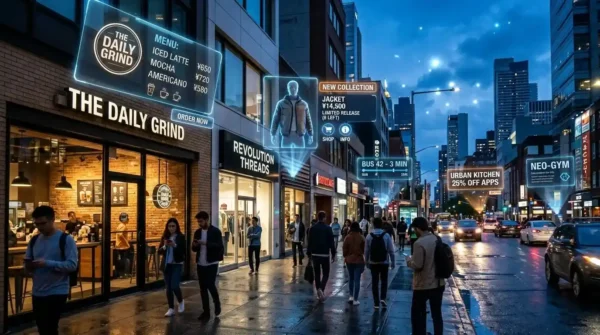
The global digital economy relies almost entirely on visual ad placements optimized for vertical smartphone screens. When those screens completely disappear, the traditional advertising playbook becomes utterly obsolete across international consumer markets. In an augmented reality environment, advertising transforms from flat banners into interactive, hyper-localized spatial experiences. A restaurant will no longer buy a search ad; instead, it will project a dynamic 3D menu over its physical storefront.
This means that digital real estate will become directly tied to actual, physical geographic coordinates across the real world. Brands will engage in massive bidding wars to occupy the spatial layers over highly trafficked metropolitan areas. E-commerce workflows will allow users to instantly look at a physical object in public, view its pricing metrics, and buy it immediately. The entire world becomes a frictionless digital storefront, turning everyday walks into continuous shopping experiences.
To prevent this immersive landscape from transforming into an unlivable dystopian nightmare, strict spatial ad-blocking software will become essential. Users will demand total control over what digital assets are allowed to penetrate their immediate field of vision. Tech companies that prioritize clean, non-intrusive spatial design will win the long-term trust of global consumer bases. The monetizable real estate is infinite, but human psychological tolerance for visual noise is strictly limited.
The Impact of Post-Screen Technology on Human Cognition
The transition away from handheld screens will profoundly reshape human cognitive development, memory retention, and spatial awareness metrics. Currently, smartphones act as external cognitive hard drives, causing humans to offload basic navigation and information recall to pocket devices. When technology transitions onto facial wearables and neural implants, this cognitive symbiotic relationship becomes intimately deep. Information will appear instantly within your consciousness, removing the distinct boundary between learning and searching.
This real-time access to contextual data will dramatically accelerate professional training workflows, surgical procedures, and engineering tasks. A technician will be able to repair a complex jet engine while step-by-step holographic schematics are overlaid directly onto the machinery. However, this absolute reliance on digital overlays could severely degrade baseline human spatial memory and independent problem-solving capabilities. If the tracking system fails, individuals may find themselves completely helpless within their physical environments.
Furthermore, neuroscientists are actively studying the long-term psychological impacts of living within a permanently augmented reality framework. Constantly filtering the physical world through digital lenses could trigger deep states of depersonalization and cognitive fatigue. Balancing technological immersion with raw, unfiltered biological reality will become a vital mental health discipline for future generations. The ultimate challenge of the post-smartphone era is retaining our fundamental human connection to reality.
Summary of the Next-Generation Computing Value Matrix
As we transition into this uncharted computational landscape, each platform architecture introduces severe structural trade-offs that consumers must evaluate. The future is an intersection of absolute physical freedom coupled with immense technical data challenges.
Core Advantages
- Anatomical and Ergonomic Liberation: Removes the severe neck strain and posture fatigue caused by traditional handheld devices.
- Infinite Digital Screen Real Estate: Transforms any bare wall or room into a massive, multi-window high-resolution workstation.
- Frictionless Contextual Intelligence: Delivers critical, real-time AI assistance completely hands-free via natural biological inputs.
- Immersive Human Social Connectivity: Bridges global distances through photorealistic volumetric avatars that accurately mirror human emotion.
Notable Disadvantages
- Severe Battery Physics Constraints: Lightweight wearable frames are limited by modern energy density limits and thermal output.
- Unprecedented Biometric Privacy Risks: Continuous tracking of pupil dilation and eye motion exposes intimate psychological user profiles.
- Intense Cognitive Adaptation Curves: Requires significant psychological and neurological adjustment to balance digital overlays with physical reality.
- Geopolitical Supply Chain Vulnerabilities: Critical spatial optics components are heavily concentrated within volatile manufacturing regions.
Conclusion
Ultimately, the transition away from mobile screens is a mandatory industrial evolution driven by biological limits and market saturation. As the global computing landscape prepares to fragment into smart eyewear, ambient voice networks, and neural interfaces, the phone will regress. The smartphone will eventually occupy the same secondary productivity space currently held by stationary desktop personal computers.
While the near-term deployment face is restricted by battery life and privacy concerns, the trajectory remains completely unstoppable. When we analyze why tech giants envision a future beyond smartphones, the ultimate goal becomes transparently clear. They are building a world where the boundary between human intent and machine execution is completely erased forever.
“Editorial Note: This technology analysis is provided by XXBritsh to explore the future of spatial computing and digital hardware ecosystems.”
Frequently Asked Questions (FAQs)
Why exactly do tech giants envision a future beyond smartphones right now?
The primary driver is total market saturation coupled with severe hardware innovation limitations. Mobile devices have reached a plateau where minor design iterations no longer stimulate massive global consumer upgrading cycles.
Will AR smart glasses replace my smartphone completely by next year?
No, the transition will scale gradually over the next three to five years due to battery limits. Early adoption phases require smart glasses to work as wireless accessories linked to a pocket hub.
How does spatial computing protect users from repetitive strain injuries?
By casting digital displays directly into your natural field of vision, it eliminates head-tilting habits. This lifts structural strain away from your cervical spine and delicate hand tendons.
What is the primary processing challenge for screenless AI wearables?
To keep the hardware thin and lightweight, companies must split processing workloads. They utilize lean on-device NPU chips for basic tasks while offloading heavy data modeling to cloud systems.
Are public cameras on smart glasses legal under current privacy laws?
International privacy boards are actively revising data regulations to handle always-on smart eyewear. Most consumer models include mandatory physical LED recording indicators to warn nearby individuals.
How will the digital advertising model change in a post-screen era?
Flat screen banners will transform into hyper-localized 3D spatial experiences linked to physical coordinates. Advertisers will bid to overlay interactive elements on real-world storefronts and public spaces.
Can left-handed or colorblind users operate spatial interfaces comfortably?
Yes, next-generation spatial operating systems feature incredibly advanced biometric calibration menus. They can easily remap gesture inputs and color gamuts to match individual physiological profiles.
What happens if the internal battery of a neural implant fails?
Devices like Neuralink use advanced wireless induction charging systems that refresh power safely through the skin. The hardware features multiple redundant safety shutoffs to protect biological tissue.
Will traditional mobile app stores exist in the ambient computing era?
App stores will transform into unified AI plugin networks where standalone interfaces will drop significantly. Users will interact with centralized AI agents that pull data fields dynamically without manual app management.
Is the hardware used for spatial computing safe for child development?
Neuroscientists are currently running long-term tracking studies regarding spatial depth perception in children. Most current consumer headsets feature explicit age guidelines to protect developing visual systems.